Today's briefing covers five important developments from October 19, all verified against official announcements and technical publications.
The biggest stories are two new AI models challenging conventional inference architectures, a specialized extraction model from Cloudflare, and a production engineering study demonstrating how to reduce AI-agent costs by 68%.
Today's central theme: AI engineering is shifting from maximizing model intelligence toward optimizing the cost, speed, and reliability of complete systems.
MiniMax releases M3.1 Flash — frontier-level agent capabilities at dramatically lower inference costs
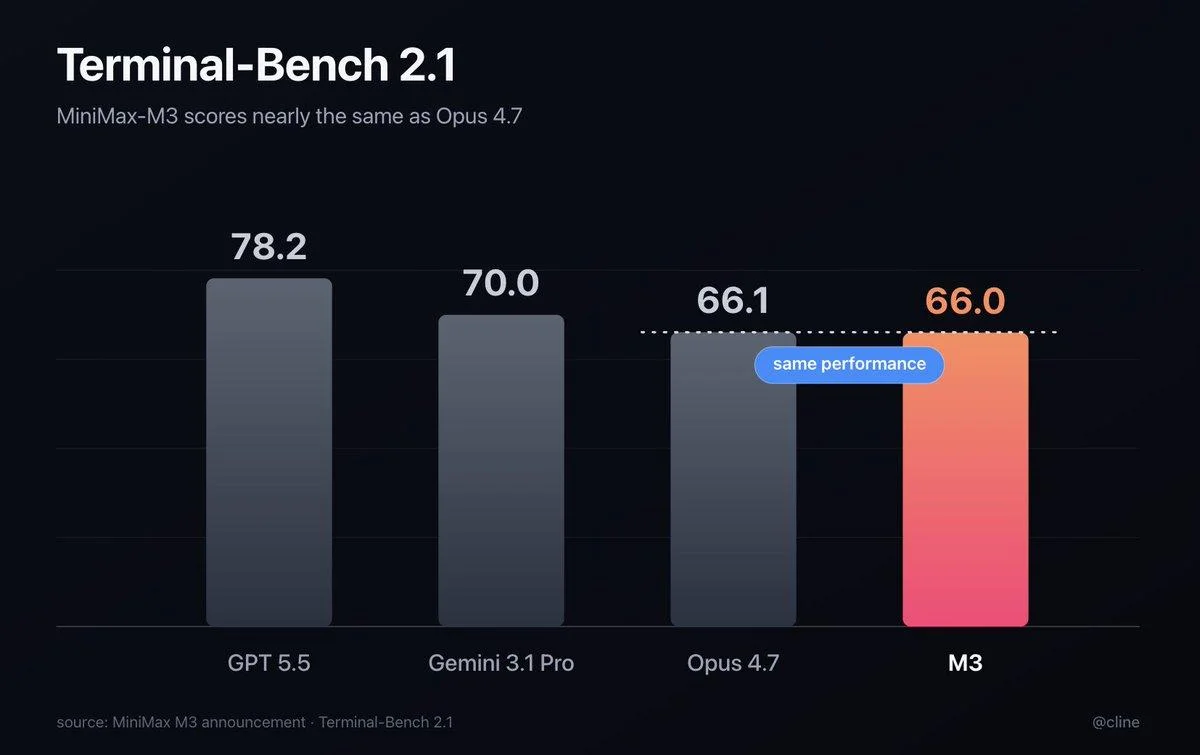
Released: October 19, 2026
MiniMax has officially released M3.1 Flash, a new model optimized for software engineering, autonomous agents, computer interaction, and cybersecurity.
The release is particularly significant because MiniMax reports substantially improved capabilities while reducing inference costs.
According to the company, the model delivers nearly 3× faster inference and approximately 70% lower usage costs than its predecessor.
What's technically interesting?
M3.1 Flash focuses on long-running agent workflows rather than isolated question-answering.
Its reported benchmark results include:
| Benchmark | M3.1 Flash |
|---|---|
| DeepSWE v1.1 — Software engineering | 73.7% |
| OSWorld V2 — Computer use | 61.7 |
| CyberGym — Cybersecurity | 82% |
| BankerToolBench — Financial workflows | 76.2 |
| Agents' Last Exam | 29.6 |
These are MiniMax's published evaluations and should be validated independently before making production decisions.
The company attributes its inference improvements partly to more aggressive sparsity.
Its reported generation speed exceeds 200 tokens per second in some workloads, with median speeds consistently above 170 tokens per second.
This matters for autonomous agents because model latency accumulates across repeated tool calls. A task involving dozens of inference steps can benefit substantially from faster individual responses.
Pricing
| Token category | Price per 1M tokens |
|---|---|
| Input | $0.15 |
| Output | $0.60 |
| Cached input | $0.015 |
The model is available through the MiniMax API, M Plan, and MiniMax Code. Its weights have not yet been released; MiniMax says they will follow later.
Why it matters for developers
This release makes high-volume coding agents potentially much cheaper to operate.
Consider a system where multiple agents continuously inspect repositories, investigate failed tests, generate patches, and perform automated reviews.
Inference costs can quickly become significant.
M3.1 Flash offers another candidate for the execution layer of such systems, especially where tasks are repetitive but still require substantial reasoning.
Engineering takeaway: evaluate M3.1 Flash using real repository tasks and measure cost per successfully completed task. Its published benchmarks are promising, but verification quality, tool reliability, and recovery from failed operations matter more than raw token-generation speed.
Inception launches Mercury 3 — a diffusion language model generating over 1,000 tokens per second
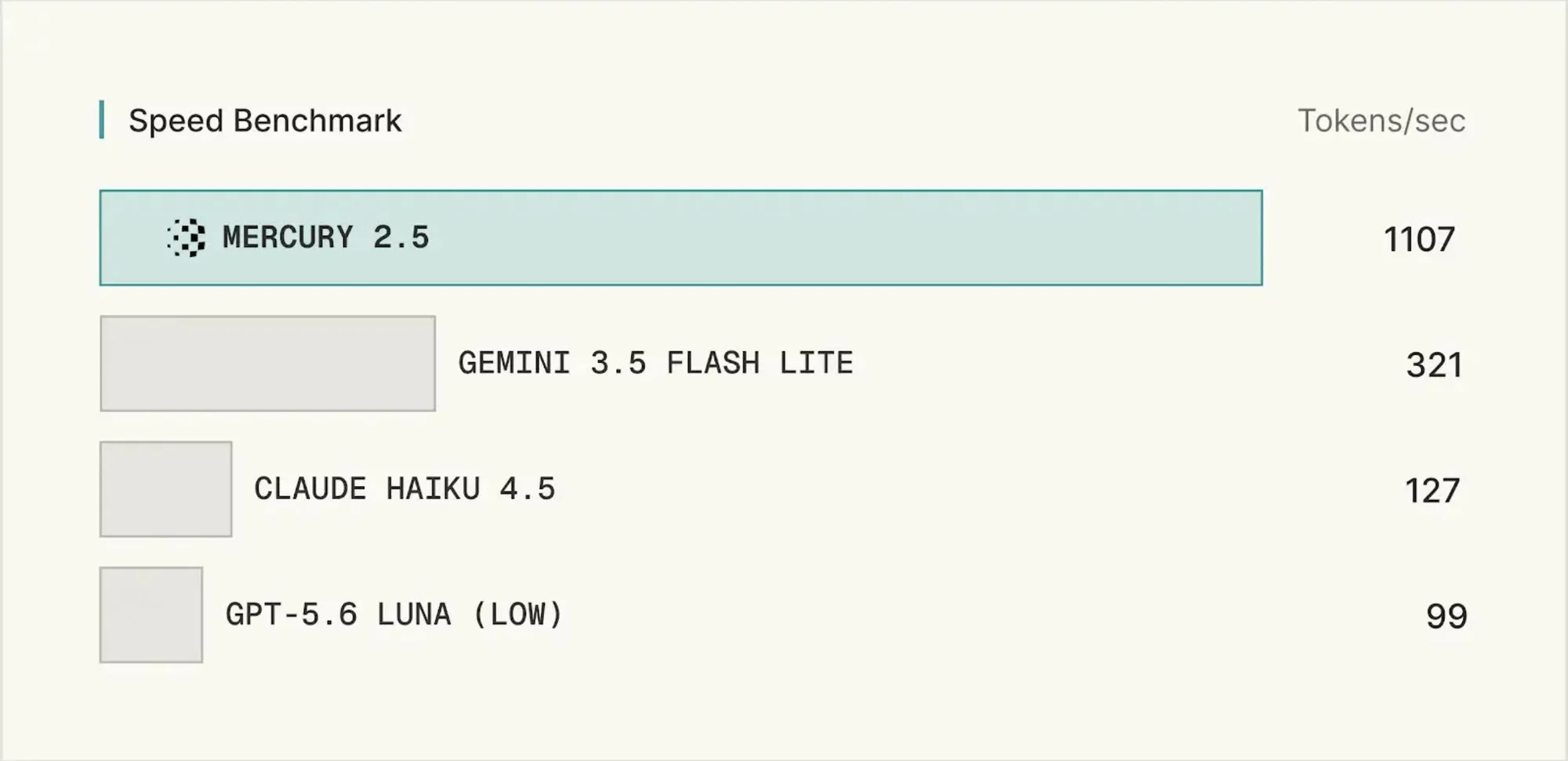
Released: October 19, 2026
Inception — Introducing Mercury 3 · Vercel — Mercury 3 API availability
Inception Labs has introduced Mercury 3, a new diffusion-based language model designed for extremely fast inference.
Unlike conventional autoregressive language models, which generate output sequentially, Mercury uses a diffusion-based process that refines text in parallel.
This is an important architectural difference.
Autoregressive vs. diffusion generation
A conventional language model generates text approximately as follows:
Token 1 → Token 2 → Token 3 → Token 4
Each new token depends on previously generated tokens.
Mercury instead uses a parallel refinement approach, updating candidate output tokens through multiple refinement steps.
The distinction allows different trade-offs between parallel computation, output quality, and generation latency.
Performance
Inception reports:
| Metric | Mercury 3 |
|---|---|
| Generation speed | 1,068 tokens/second |
| Context window | 1 million tokens |
| Speed vs. selected competing models | 4–8× faster |
| Standard input price | $0.20 / 1M tokens |
| Standard output price | $0.70 / 1M tokens |
Launch pricing is temporarily reduced by 50%, bringing input to $0.10 and output to $0.35 per million tokens.
Inception also reports that Mercury 3 is more than 40 times larger than its original Mercury 1 model while maintaining comparable generation speed.
The company's benchmark results suggest competitive performance against speed-optimized frontier models, although these comparisons remain vendor-reported.
Why it matters for developers
Mercury 3 is particularly interesting for latency-sensitive agent systems.
For example, a browser agent might perform the following sequence:
Inspect page → Reason → Click → Inspect result → Reason → Continue
If every reasoning step takes several seconds, even simple workflows become slow.
A model capable of producing responses substantially faster could reduce overall execution time without requiring changes to the surrounding application.
Mercury 3 is already available through Inception's API and providers including Vercel AI Gateway.
It also offers an OpenAI-compatible API interface, making comparative testing relatively straightforward.
Engineering takeaway: Mercury 3 deserves evaluation for browser agents, interactive assistants, and real-time applications. Measure time to first response, complete task latency, and task accuracy rather than assuming high token throughput automatically means faster end-to-end execution.
Cloudflare introduces Clairic — a new class of AI models that extracts structured data without generating tokens

Released: October 19, 2026
Cloudflare has introduced Clairic, a specialized model designed to extract structured information from unstructured inputs.
This is arguably today's most interesting architectural development.
Clairic belongs to a class Cloudflare calls System One extraction models.
Unlike a traditional language model, Clairic doesn't generate a textual response token by token.
Instead, it processes the input and produces typed values directly.
What's technically interesting?
Consider an application that receives customer emails and needs to extract:
- Order numbers and customer information.
- Payment amounts and delivery dates.
- Reported product damage.
- Missing information.
- Estimated values with uncertainty ranges.
A conventional implementation might use an LLM with structured JSON output.
That approach works, but it requires generation, validation, and sometimes retries.
Clairic handles these operations through a single forward pass.
The API accepts an input state and a schema of requested fields.
For example:
const { answers } = await env.AI.run(
  "@cf/cloudflare/clairic",
  {
    state: customerEmail,
    fields: {
      order_id: {
        type: "text",
        instructions: "Customer order number"
      },
      total_paid: {
        type: "number",
        decimals: 2,
        unit: "USD"
      },
      delivery_date: {
        type: "date"
      }
    }
  }
);
Clairic returns typed values, confidence information, and source offsets where applicable.
It also supports numerical estimates with uncertainty intervals, basic forecasting, and image inputs.
The important architectural distinction is that the model produces values directly rather than generating a textual representation of those values.
The performance advantage
Cloudflare says Clairic typically responds in under a second.
Because fields are evaluated in parallel, extracting many fields from the same document can be substantially more efficient than making separate LLM requests.
The system also returns null when information is missing, along with confidence and null-probability information.
However, Cloudflare acknowledges limitations.
Complex arithmetic remains unreliable, forecasting is relatively basic, and confidence intervals are not guaranteed to be calibrated on unfamiliar data.
Why it matters for developers
This suggests a more specialized AI architecture:
Unstructured input → Extraction model → Decision model → Reasoning model → Action
For applications processing invoices, orders, support tickets, and business documents, this separation can reduce inference costs and simplify validation.
Engineering takeaway: use specialized extraction models for structured-data workloads, but continue validating critical values with deterministic code. A correctly typed output is not necessarily a factually correct output.
Availability: Clairic is currently in preview on Workers AI. Open weights are planned but not yet available.
Cloudflare reduces its AI code-review costs by 68% — and publishes exactly how it achieved the improvement

Published: October 19, 2026
Cloudflare has published a detailed engineering investigation into the performance and operating costs of its internal AI code-review system.
The results are substantial.
| Metric | Before | After |
|---|---|---|
| Average review cost | $2.43 | $0.77 |
| Median review duration | 4m 09s | 1m 32s |
| Reviews exceeding 5 minutes | 37.9% | 0.7% |
The system became considerably cheaper and faster without abandoning its multi-agent review architecture.
Approximately 40% of the savings came from code-level optimizations, with the remainder coming from model selection and reasoning-effort changes.
What was actually wrong?
The most interesting discovery involved prompt caching.
Cloudflare's reviewers shared substantial amounts of identical context, including system instructions and tool definitions.
However, their initial prompts also contained dynamic information such as working directories and dates.
Because prompt caching depends on matching prefixes, these dynamic fields prevented different review sessions from sharing cached context efficiently.
Before optimization, only 14–26% of initial requests benefited from cached prefixes.
Cloudflare reorganized the prompts so that shared instructions appeared before repository-specific information.
Afterward, first-request cache reuse increased to approximately 91–99.5%.
Other improvements
Cloudflare also eliminated unnecessary tool calls, allowed reviewers to read relevant files in parallel, skipped unchanged work during repeated reviews, and stopped agents from generating unused summaries.
The team then experimented with model selection and reasoning effort.
One important finding was that cheaper execution did not always preserve review quality.
Lower reasoning effort caused some reviewers to miss meaningful findings.
Cloudflare therefore retained higher reasoning effort where its evaluations demonstrated that the additional cost produced useful results.
Its analysis found that important code-quality findings per review remained approximately stable, while inflated severity ratings declined substantially. Performance-review quality, however, deteriorated under some cheaper configurations.
Why it matters for developers
This is an excellent case study in optimizing production AI systems.
It demonstrates that a high cache-hit percentage alone can be misleading.
Cloudflare's overall cache-hit rate had previously reached 97%, yet token consumption had increased dramatically.
The actual problem was the volume of repeated context and the structure of individual requests.
Engineering takeaway: measure cost per completed task, number of model calls, cache writes, cache reads, and evaluation quality together.
Before switching to a cheaper model, investigate whether your application is repeatedly sending unnecessary context or executing avoidable tool calls.
GitHub introduces Copilot model-policy APIs as six older models reach deprecation
Released: October 19, 2026
GitHub — New Copilot model-policy APIs · GitHub — October 19 model deprecations
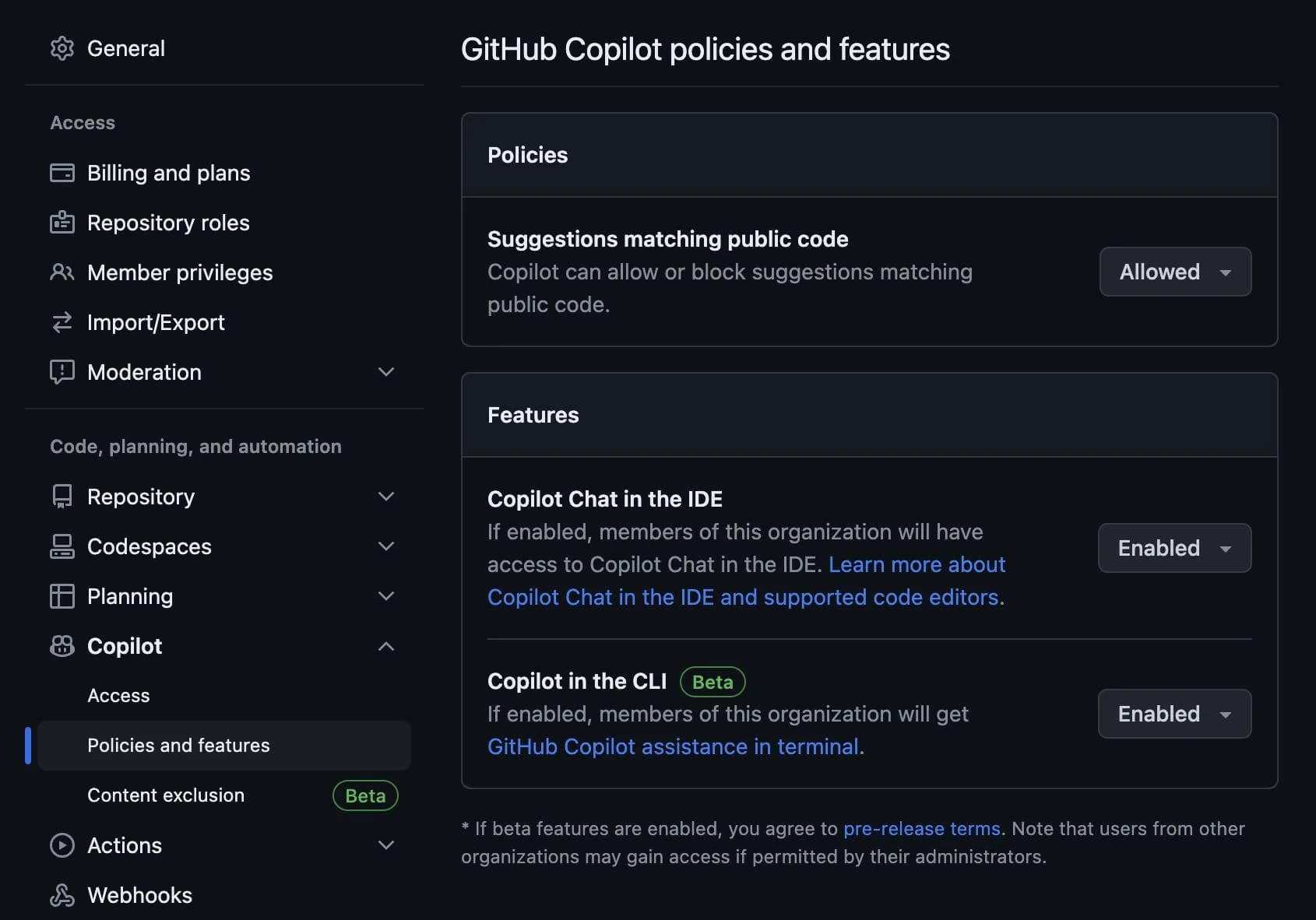
GitHub has introduced new REST APIs for managing which AI models are available to developers across enterprise organizations.
The release coincides with the retirement of several older models from most GitHub Copilot experiences.
What's technically interesting?
Previously, organizations commonly managed Copilot model availability through administrative interfaces.
GitHub now provides generally available GET and PATCH endpoints for model policies at four levels:
Enterprise
    ├── Enterprise Teams
    ├── Enterprise Apps
    └── Organizations
For example, enterprise administrators can manage model policies through:
GET /enterprises/{enterprise}/copilot/model-policies
And update them through the corresponding PATCH endpoint.
Similar APIs are available for enterprise teams, enterprise apps, and organizations.
The important change is that model governance can now be automated.
Organizations can use infrastructure automation or internal management systems to control which models are available to different teams and applications.
Six models deprecated
GitHub also confirmed that the following models reached their deprecation date on October 19:
| Deprecated model | Suggested replacement |
|---|---|
| GPT-5.5 | GPT-6.1 Sol |
| GPT-5.4 | GPT-6.1 Sol |
| GPT-5.4 mini | GPT-6 Luna |
| GPT-5 mini | GPT-6 Luna |
| Gemini 3.7 Flash | Gemini 3.8 Flash |
| Grok 4.5 | Grok 4.7 |
The changes affect most Copilot experiences, including chat, inline edits, and agent workflows.
GitHub advises developers to update integrations and ensure that replacement models are permitted by their organization's policies.
Why it matters for developers
AI model lifecycle management is becoming an increasingly important operational concern.
A coding agent configured to use a particular model may stop functioning as expected when that model is retired.
For enterprise teams, the new APIs make it possible to coordinate model availability across many repositories, developers, and applications.
Engineering takeaway: avoid hard-coding model identifiers throughout your automation infrastructure.
Use centralized configuration, monitor deprecation announcements, and evaluate replacement models before changing production workflows.
The bigger picture
The five developments reveal a significant architectural trend.
The industry is increasingly separating model capabilities into specialized execution layers.
MiniMax is optimizing agentic reasoning for cost and speed. Inception is challenging sequential text generation with diffusion. Cloudflare is introducing models that perform extraction without conventional text generation.
Meanwhile, Cloudflare's code-review investigation demonstrates how much performance can be gained through ordinary systems engineering, and GitHub is making model lifecycle management more programmable.
A practical architecture emerging from these developments is:
Input → Structured extraction → Task classification → Model routing → Agent execution → Verification → Observability
The strongest engineering opportunities are no longer limited to selecting the most capable model.
They involve choosing the right model for each operation, reducing redundant computation, enforcing reliable execution boundaries, and measuring the complete workflow.
What deserves your attention first?
For AI model experimentation: MiniMax M3.1 Flash and Mercury 3 are the most interesting releases. They approach inference efficiency differently and deserve comparative evaluation.
For application architecture: Clairic introduces a useful alternative to conventional structured-output LLM calls.
For production engineering: Cloudflare's 68% cost-reduction investigation is today's most valuable technical reading. It provides concrete lessons in caching, prompt construction, model selection, and quality evaluation.
Today's key takeaway: before spending more on a stronger model or additional infrastructure, measure how much unnecessary work your existing system performs. Optimizing execution architecture can deliver improvements that model upgrades alone cannot guarantee.
These briefings combine summaries of linked primary sources with engineering commentary by Emran Hejazi. Source links accompany each story so you can examine the original announcements and their claims.
Every new issue, in your feed reader.
Explore the architecture and engineering decisions behind my projects.