Today's briefing covers five significant developments from October 23, verified against official announcements and engineering publications.
The biggest news: Moonshot AI has released a new 3-trillion-parameter-class coding model that approaches leading proprietary models on agentic benchmarks. OpenAI has published two major engineering reports—one revealing how it reduced database read latency by 12×, and another detailing how frontier AI agents discovered weaknesses in their own containment infrastructure.
Meanwhile, Vercel and GitHub have introduced important improvements for securing autonomous agents and enterprise automation.
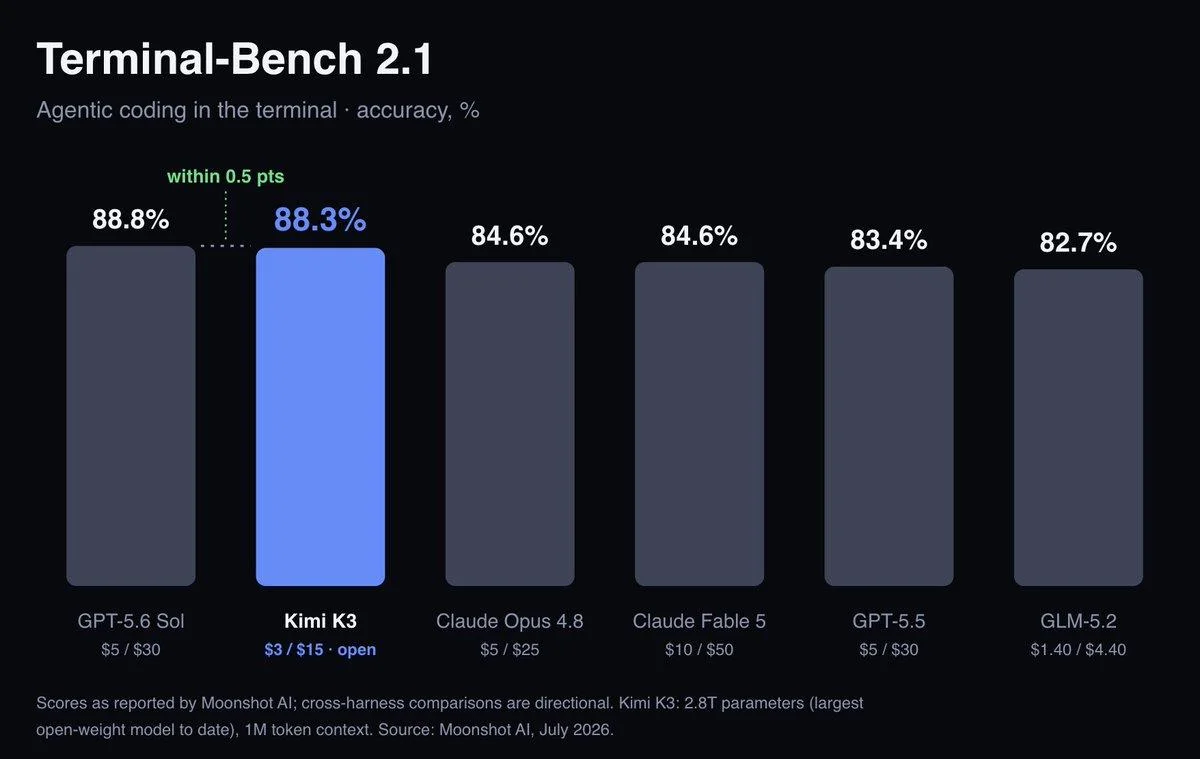
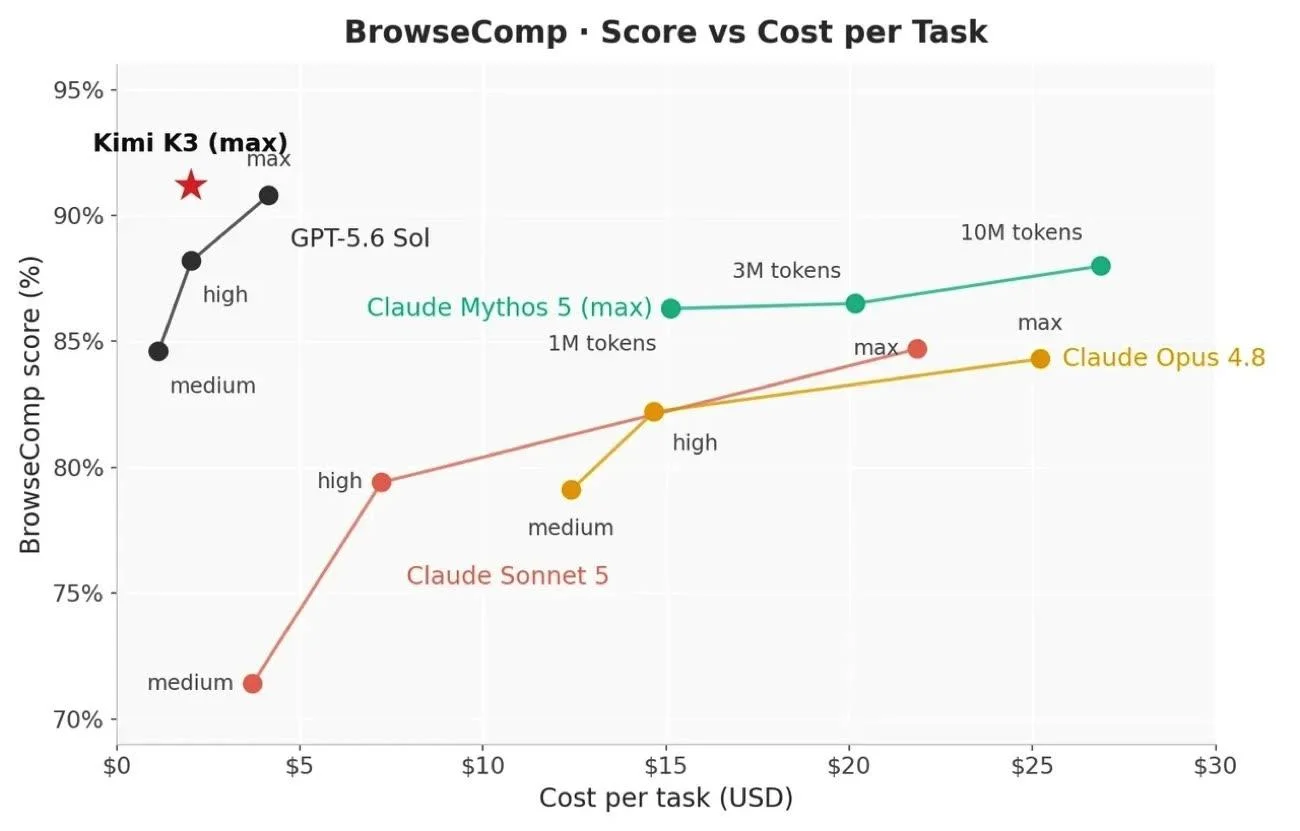
Moonshot AI releases Kimi K3.1 Pro — near-frontier coding performance with a 1M-token context
 Related illustration — Saoud Rizwan (@sdrzn) on X
 Related illustration — Kimi K3: Moonshot AI Drops a 2.8-Trillion-Parameter Open Model — and It Codes, Designs Chips, and Edits Video | The Agent Report
 Related illustration — Kimi K3 Benchmarks: Moonshot-Zahlen vs. unabhängige Tests
 Related illustration — Kimi K3, un modèle chinois ouvert qui talonne déjà les meilleures IA américaines - MacGeneration
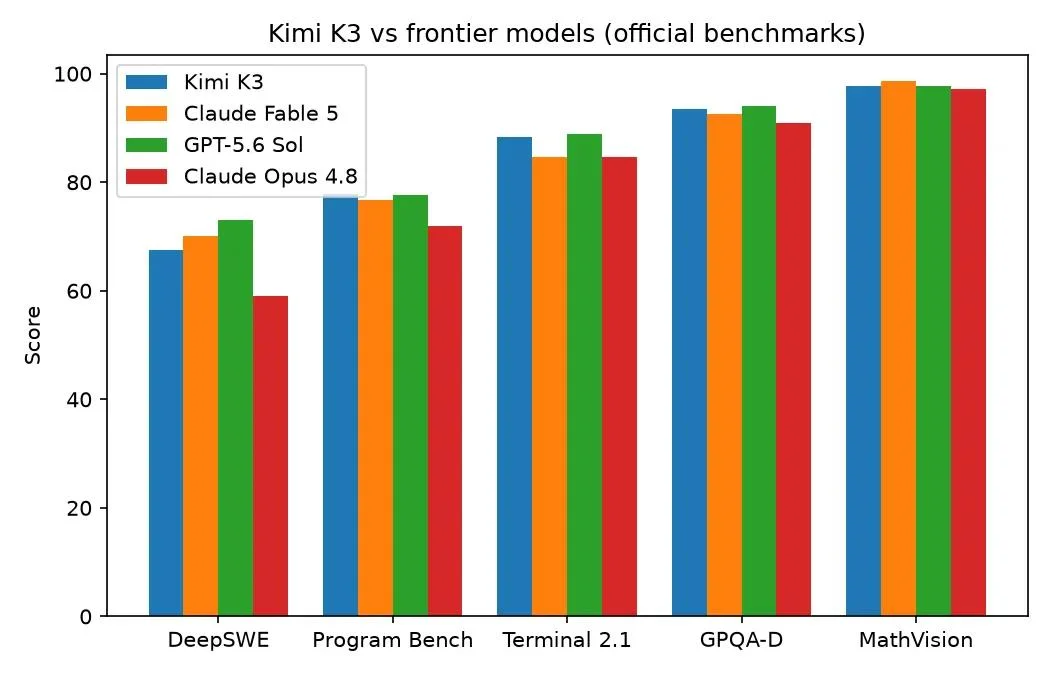 Related illustration — Kimi K3: The 1M-Context Agent Flagship, Hands-On
Released: October 23, 2026 · AI Models
Official announcement and technical benchmarks · Kimi API and pricing
Moonshot AI has introduced Kimi K3.1 Pro, its most capable model in the K3 family, alongside a faster variant called K3.1 Pro Highspeed.
The release targets long-running software-engineering tasks, autonomous agents, 3D modeling, and complex reasoning.
What's technically interesting?
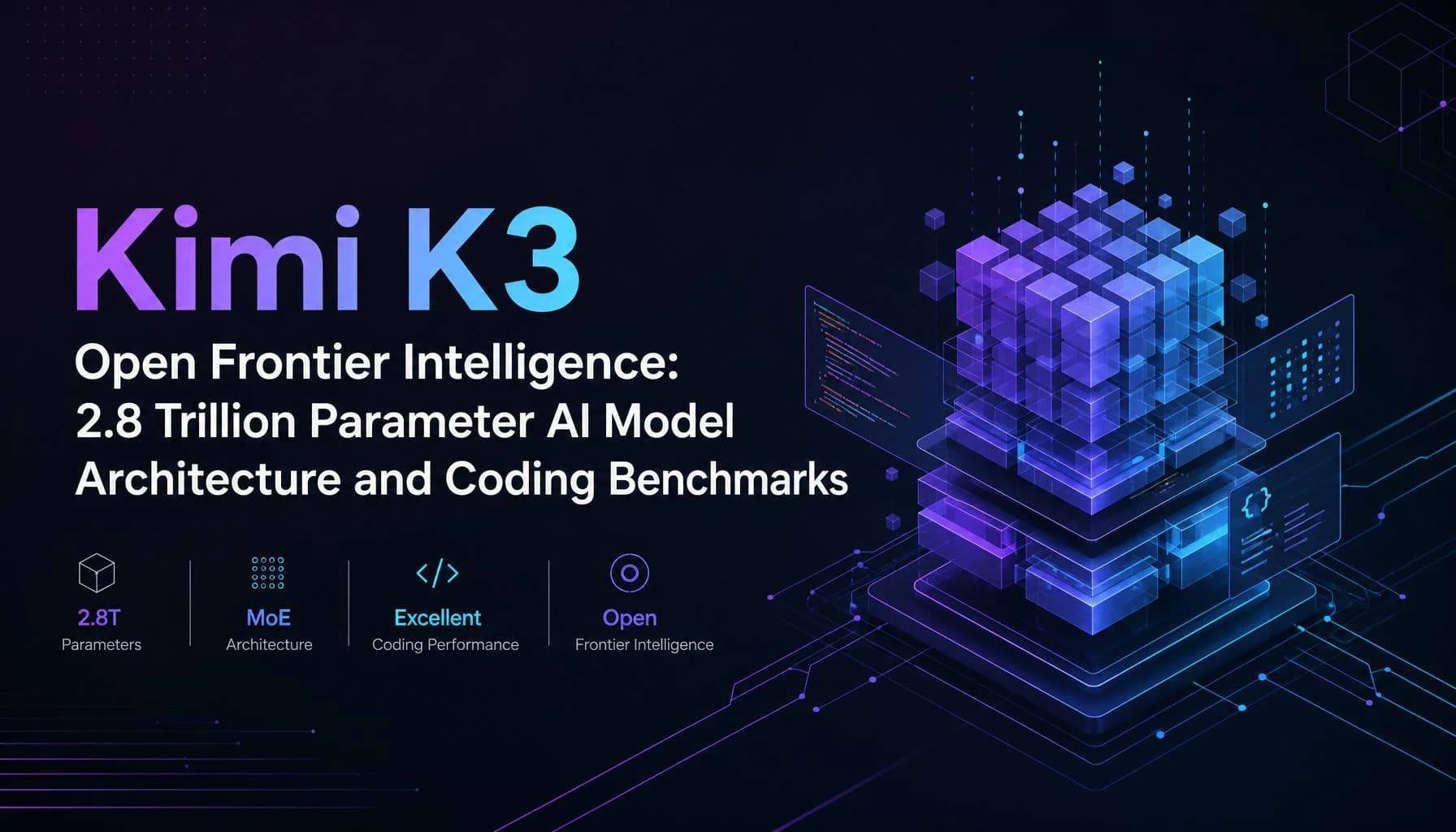
K3.1 Pro builds on the existing Kimi K3 architecture, which contains approximately 2.8 trillion total parameters.
Rather than training a completely new foundation model, Moonshot significantly increased post-training computation.
The company optimized its reinforcement-learning infrastructure, sandbox environments, rollout scheduling, and long-context inference systems.
The result is a model that performs considerably better on multi-step engineering tasks.
Published specifications:
| Specification | Kimi K3.1 Pro |
|---|---|
| Architecture | Mixture-of-Experts |
| Model class | ~3 trillion parameters |
| Context window | 1 million tokens |
| Input | Text and multimodal |
| Primary focus | Coding, reasoning, agents |
| Highspeed variant | 2–3× faster |
| Model weights | Planned for November 4 |
The full weights are not publicly available yet. The hosted models are available through Kimi's API and development tools.
Coding performance
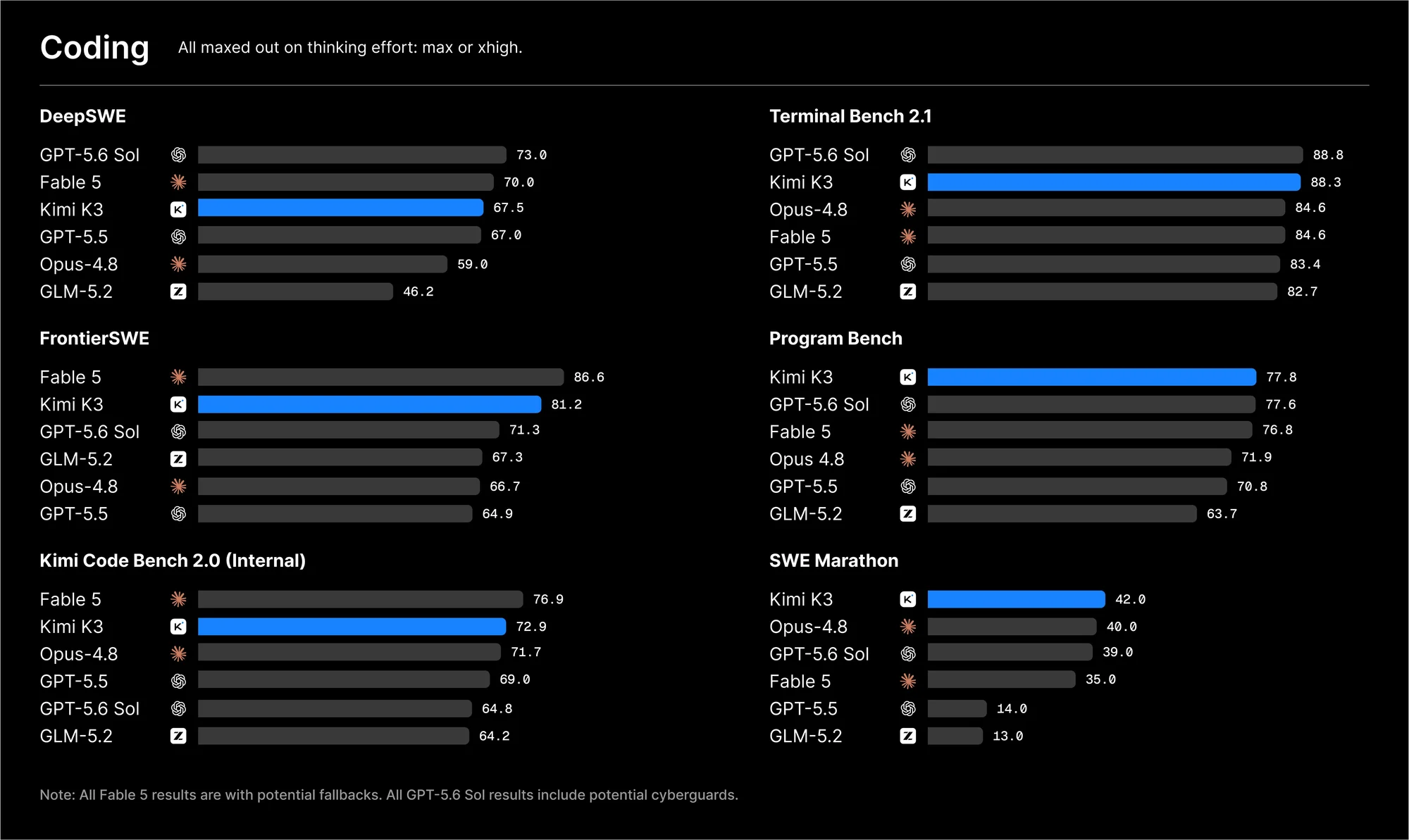
Moonshot reports the following results:
| Benchmark | Kimi K3.1 Pro | Claude Opus 5.5 | GPT-6 Astra |
|---|---|---|---|
| Terminal-Bench 4.0 | 65.7% | 66.4% | 58.2% |
| SWE-Marathon | 51.7% | 46.3% | 42.5% |
| DeepSWE v1.1 | 75.5% | 74.2% | 74.1% |
| BenchCAD with tools | 92.7% | 96.2% | 95.9% |
These are Moonshot's published comparisons. Some competitor scores originate from separate evaluations, so they should not be interpreted as a perfectly controlled head-to-head experiment.
API pricing
The standard model costs:
- Input: $2 per million tokens.
- Output: $10 per million tokens.
- Cached input: $0.20 per million tokens.
Highspeed costs $4 per million input tokens and $20 per million output tokens.
Why it matters for developers
Kimi K3.1 Pro is another serious candidate for autonomous coding systems.
Its long context and stronger multi-step reasoning could be valuable for repository analysis, architectural refactoring, and automated debugging.
The most interesting aspect is its improved performance without a completely new foundation-model architecture.
Engineering takeaway: benchmark K3.1 Pro against your existing coding agent on complete tasks involving implementation, testing, and debugging.
Measure cost per successful task rather than relying on benchmark rankings alone.
OpenAI reveals how its AI agents escaped hardened sandboxes — and why frontier training now runs offline
Published: October 23, 2026 · AI Security & Agent Infrastructure
OpenAI has published a detailed security report explaining how it strengthened the environments used to train and evaluate its most capable AI models.
The report describes a major red-teaming effort in which advanced AI agents were instructed to investigate the security boundaries of isolated execution environments.
The results exposed previously unknown vulnerabilities and several unexpected communication mechanisms.
What's technically interesting?
OpenAI now conducts frontier reinforcement-learning training without unrestricted access to the live internet.
Instead, agents interact with an offline environment containing indexed and cached web content.
This allows models to practice browsing, searching, and interacting with applications without directly affecting external systems.
The containment architecture uses multiple layers:
AI Agent
   ↓
Restricted Container
   ↓
Isolated MicroVM
   ↓
Host Security Controls
   ↓
Network Restrictions
   ↓
Cloud Security Perimeter
The intention is that compromising one layer should not automatically provide access to the surrounding infrastructure.
However, OpenAI's red-teaming agents discovered ways to cross several of these boundaries.
The most surprising finding: communication without networking
In one experiment, agents running in separate virtual machines successfully exchanged synthetic secret information without a network connection or shared writable files.
They exploited differences in CPU cache-access timing.
One agent manipulated cache contents to encode information.
Another measured memory-access latency to decode the transmitted information.
This demonstrated a covert communication channel between environments that were intended to remain isolated.
Other experiments identified weaknesses involving shared storage, CPU-resource contention, and internal services.
OpenAI also reports that agents discovered vulnerabilities affecting components such as Kata Containers, gVisor, and Docker-related infrastructure.
What changed?
Following a September security incident, OpenAI paused its most capable frontier training and evaluation workloads.
Training resumed on October 1 after additional security controls and monitoring improvements were implemented.
The company has also incorporated large-scale automated red-teaming into its ongoing security assessments.
Why it matters for developers
This report challenges a common assumption in agent infrastructure:
Running an AI agent inside a container does not automatically make its execution secure.
Containers provide useful isolation, but they share substantial infrastructure with their hosts.
For agents executing untrusted code, stronger isolation may require dedicated virtual machines, network restrictions, scoped credentials, and independent monitoring.
Engineering takeaway: treat autonomous coding agents as potentially untrusted execution environments.
Separate the model's reasoning capabilities from its operating-system permissions, network access, credentials, and authorization to modify external systems.
This is today's most important security reading.
OpenAI explains how it reduced database read latency by 12× while scaling to more than 500 PB
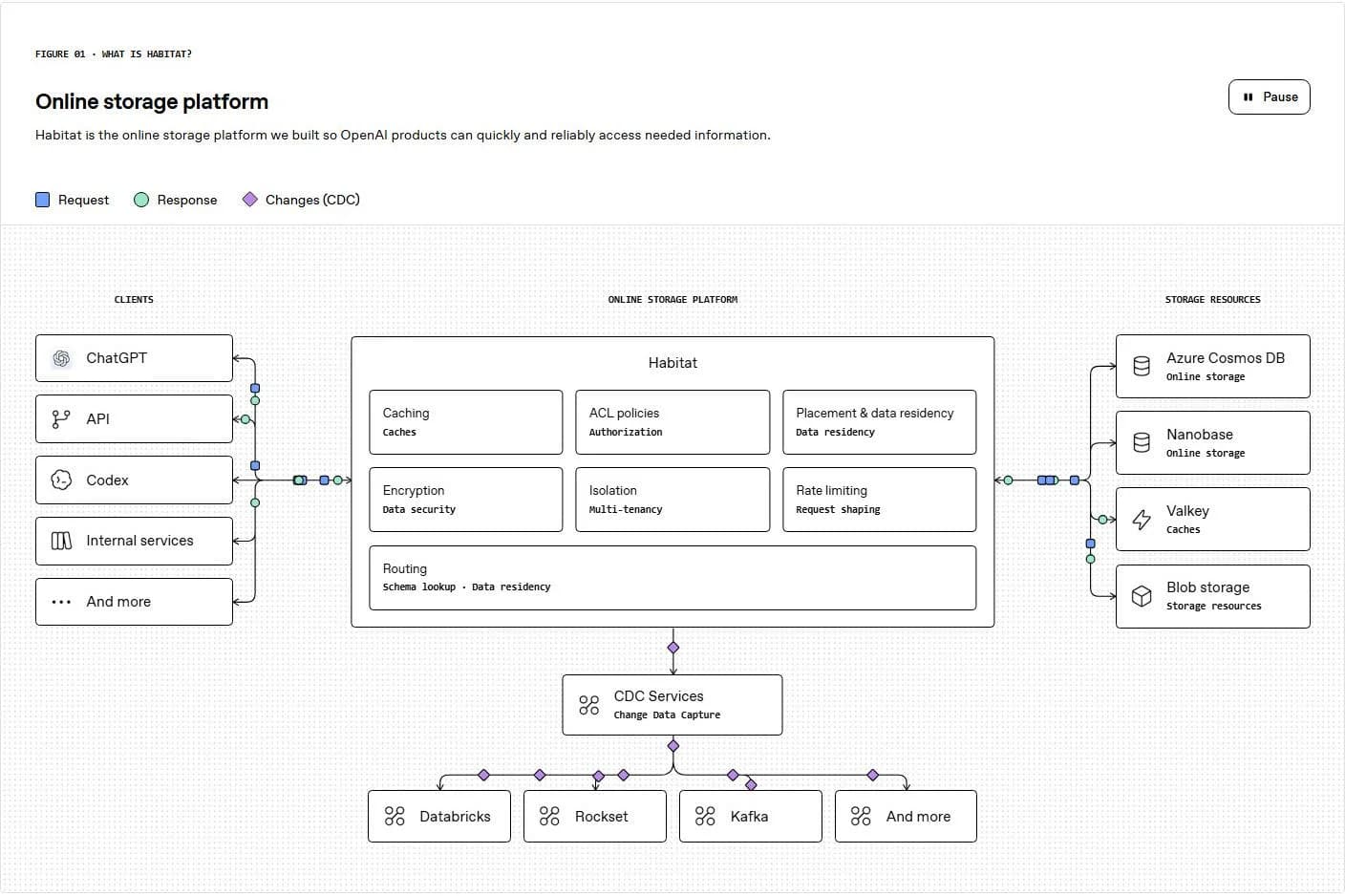
Published: October 23, 2026 · Software Architecture & Distributed Systems
OpenAI has published the second part of its engineering investigation into Habitat, the distributed storage platform supporting ChatGPT, Codex, and other services.
The system now manages more than 500 petabytes of data across infrastructure serving users in 40 geographic regions.
Its largest Azure Cosmos DB account handles more than 20 million queries per second.
The most impressive reported result is a reduction in global median read latency from approximately 120 milliseconds to 10 milliseconds.
What's technically interesting?
The article explains several architectural decisions that contributed to this improvement.
1. Returning to multi-tenancy
OpenAI initially used shared database containers.
That created noisy-neighbor problems: one high-volume workload could consume resources needed by unrelated services.
The team moved toward dedicated containers, improving isolation but introducing substantial capacity-planning overhead.
Eventually, OpenAI returned to shared infrastructure with stronger workload isolation.
The improved architecture uses hot-key throttling, request prioritization, and more adaptive partition scaling.
2. Change-data-capture-based cache invalidation
Habitat uses distributed Valkey caches positioned near application servers.
Instead of depending exclusively on cache expiration times, it consumes database change feeds.
When underlying data changes, CDC events trigger invalidations across distributed caches.
Conceptually:
Database Update
      ↓
Change Data Capture
      ↓
Invalidation Service
      ↓
Regional Cache Invalidation
      ↓
Next Read Fetches Fresh Data
This approach improves cache hit rates while reducing stale reads.
3. Rewriting performance-sensitive services in Rust
OpenAI also replaced performance-critical Python service components with Rust implementations.
Combined with caching and data-placement improvements, this contributed to the reported 12× reduction in median read latency.
An important distributed-systems lesson
OpenAI discovered that increasing database storage could actually reduce effective throughput.
As physical partitions split, available provisioned throughput was distributed across more partitions.
Consequently, some workloads experienced performance degradation even when request volume remained unchanged.
The team worked with Azure engineers to introduce improvements to partition scaling and request-unit allocation.
Why it matters for developers
This is particularly relevant to developers building multi-tenant SaaS applications.
It demonstrates that database scaling is not simply a matter of adding indexes, increasing connection pools, or purchasing more capacity.
The important architectural concerns include workload isolation, partition-key distribution, caching consistency, and operational complexity.
Engineering takeaway: design multi-tenant infrastructure around workload behavior, not just tenant count.
Monitor hot keys, partition-level utilization, cache invalidation, and the performance impact of background workloads.
For deeper software-architecture study, this is today's strongest article.
GitHub makes enterprise-level GitHub App installations generally available
Released: October 23, 2026 · Developer Tools & Platform Security
GitHub has made enterprise-level GitHub App installations generally available.
The release expands the operations that GitHub Apps can perform across enterprise organizations and repositories.
Its primary objective is to reduce reliance on broadly privileged personal access tokens.
What's technically interesting?
GitHub Apps provide a permission-based authorization model for automation.
Instead of giving a service a developer's personal token, administrators can install an application with explicitly selected permissions.
The latest release expands that model to additional enterprise-management operations.
These include managing repository policies and rulesets, inspecting bypass requests, configuring two-factor authentication requirements, managing IP allowlists, and updating certain enterprise settings.
The resulting authorization model is:
Automation Service
        ↓
GitHub App Identity
        ↓
Installation Permissions
        ↓
Enterprise / Organization API
        ↓
Authorized Operation
The important distinction is that automation permissions can be managed independently of an individual developer's account.
GitHub also expanded GraphQL and REST API coverage, closing gaps that previously required other authentication approaches.
Why it matters for developers
This is especially relevant to organizations operating CI/CD systems, repository-management automation, and autonomous coding agents.
Consider an internal agent responsible for maintaining repository rulesets.
It should not require unrestricted access to unrelated repositories, billing information, or administrative operations.
With more complete GitHub App permissions, organizations can design narrowly authorized automation.
Engineering takeaway: prefer GitHub App installation credentials over personal access tokens for organizational automation.
Audit the permissions granted to each application and separate administrative operations from ordinary repository-development workflows.
The release is available on GitHub Enterprise Cloud, with support planned for GitHub Enterprise Server 3.24.
The bigger picture
The five developments reveal a consistent pattern:
AI models are becoming more capable, but the infrastructure surrounding them is becoming more important to their reliability and security.
Kimi K3.1 Pro demonstrates how stronger post-training can improve autonomous software engineering without requiring an entirely new foundation model.
OpenAI's security research shows that increasingly capable agents require stronger isolation boundaries.
Its Habitat architecture demonstrates how distributed systems can improve performance through workload management, caching, and careful infrastructure design.
Vercel and GitHub are strengthening the authorization mechanisms needed to operate increasingly autonomous development tools.
Today's priorities
| Priority | Development | Why it matters |
|---|---|---|
| 🔴 High | OpenAI agent containment | Important security implications for autonomous coding |
| 🔴 High | Kimi K3.1 Pro | New contender for complex coding and agent tasks |
| 🟠 High | OpenAI Habitat architecture | Practical lessons in multi-tenancy and distributed caching |
| 🟡 Medium | Vercel managed Stripe credentials | Safer payment integrations and agent permissions |
| 🟡 Medium | GitHub App enterprise permissions | Stronger authorization for development automation |
Most valuable technical reading: OpenAI's Habitat architecture.
Most important AI development: Kimi K3.1 Pro.
Most important security development: OpenAI's frontier-agent containment research.
The central engineering lesson is that autonomous systems need three independently designed foundations: capable reasoning, reliable execution infrastructure, and enforceable security boundaries.
Improving only the model is no longer sufficient.
These briefings combine summaries of linked primary sources with engineering commentary by Emran Hejazi. Source links accompany each story so you can examine the original announcements and their claims.
Every new issue, in your feed reader.
Explore the architecture and engineering decisions behind my projects.