Today's briefing covers five significant developments from October 21–24, prioritizing new AI capabilities, local coding models, software architecture, and production security.
The biggest news: OpenAI has made its specialized Decisions API generally available, Recursive has introduced an open-weight coding model designed to run on laptops, and critical vulnerabilities have triggered urgent security updates for Node.js and PHP.
Spring Boot and Spring Cloud have also released new candidates containing meaningful improvements for backend developers.
OpenAI launches Decisions API — up to 10× faster AI decisions without generating text
Released: October 22, 2026 · AI Models & Developer APIs
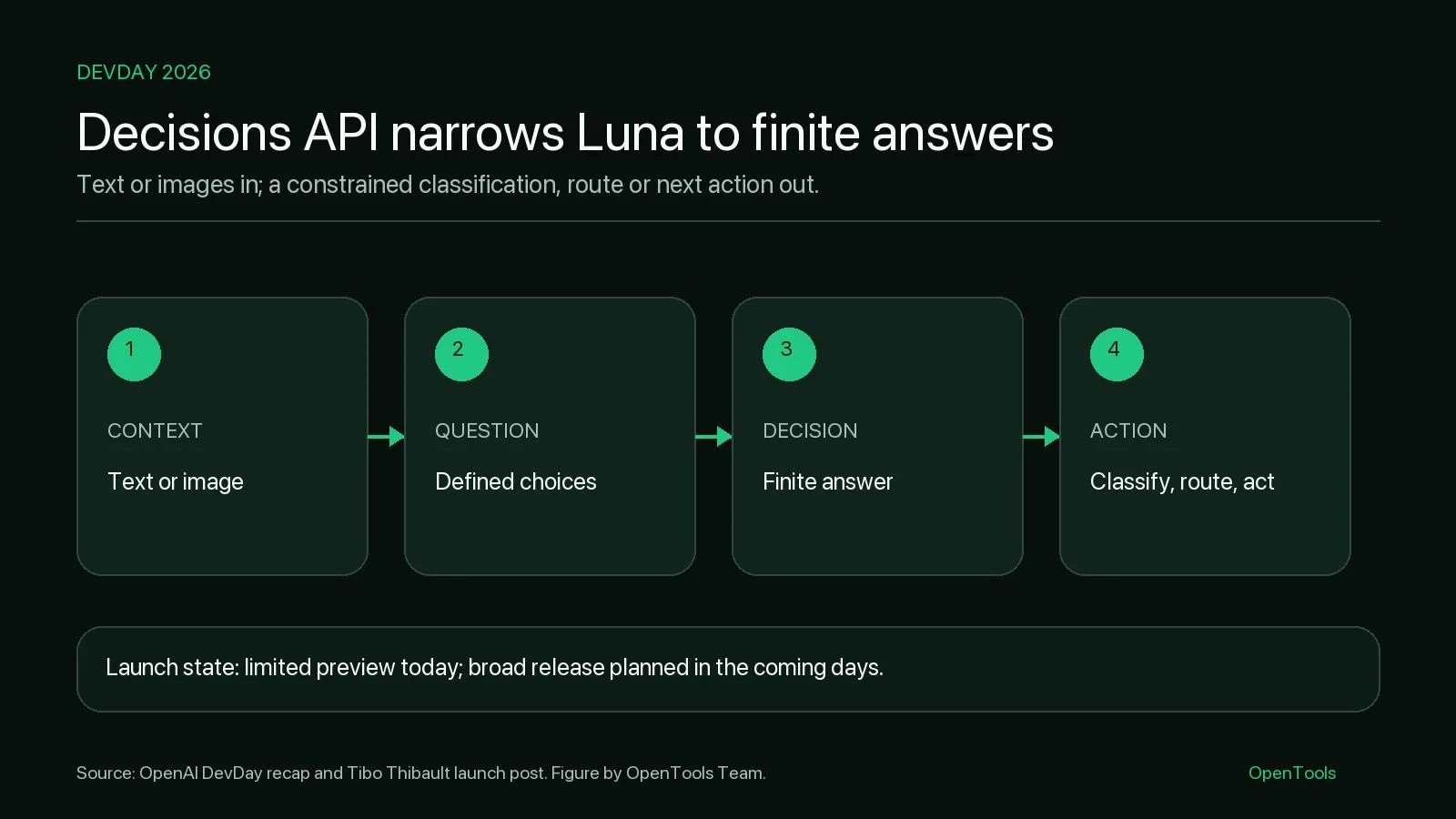
OpenAI has made its Decisions API generally available, introducing a specialized inference interface for applications that need fast, structured decisions rather than conversational responses.
Built on GPT-6 Luna, the API is designed for classification, routing, scoring, and other operations with predefined answers.
OpenAI reports that it can execute decisions up to 10 times faster than using GPT-6 Luna through the conventional Responses API.
What's technically interesting?
Traditional language models generate responses token by token.
But many application operations don't require generated text.
Consider a customer-support system that needs to determine whether a request is urgent, which department should handle it, and whether human approval is necessary.
A conventional implementation might invoke a generative model and parse its JSON response.
The Decisions API provides three specialized output types:
| Type | Purpose | Output |
|---|---|---|
predicate | Determine whether a condition is true | Probability from 0 to 1 |
choice | Select from predefined alternatives | Selected value and probabilities |
score | Evaluate against an ordered rubric | Probability-weighted score |
A single request can evaluate up to 400 questions against shared context.
The API supports text, images, and structured JSON inputs. It also introduces prompt caching and native integration with GPT-Live.
Pricing
| Category | Price per 1M tokens |
|---|---|
| Input | $0.10 |
| Cached input | $0.01 |
| Output | No output-token charge |
Why it matters for developers
This is an important step toward specialized model architectures.
Instead of using an expensive reasoning model for every operation, developers can separate decisions from reasoning.
A production architecture might look like:
Incoming Request
       ↓
Decision Model
       │
       ├── Simple → Deterministic handler
       ├── Complex → Reasoning model
       └── Sensitive → Human approval
Engineering takeaway: evaluate specialized decision models for request classification, agent routing, fraud screening, and workflow prioritization.
Use confidence thresholds and deterministic validation before allowing model decisions to trigger consequential actions.
Recursive releases Flint — a 40B open-weight coding model designed for local development
Released: October 21, 2026 · AI Models & Coding Agents
Recursive has introduced Flint, a new open-weight model optimized for fast, local software engineering.
Flint is particularly interesting because it combines a sparse architecture with an inference engine optimized for consumer hardware.
Model specifications
| Specification | Flint |
|---|---|
| Total parameters | 40 billion |
| Active parameters | 2.5 billion |
| Architecture | Mixture-of-Experts |
| Maximum context | 512K tokens |
| Recommended coding context | Up to 256K tokens |
| License | Apache 2.0 |
| Primary use | Local coding agents |
Recursive reports that Flint generates more than 125 tokens per second on an M4 Pro MacBook Pro and more than 150 tokens per second on a 64GB NVIDIA RTX Spark at short context lengths.
What's technically interesting?
Flint uses a sparse Mixture-of-Experts architecture.
Although the model contains approximately 40 billion parameters, only 2.5 billion are activated for each token.
This reduces computation while retaining the representational capacity of a larger model.
The second important development is how Flint was created.
Recursive used its automated research platform, Eureka Machine, throughout the model-development process.
The system assisted with training recipes, architecture exploration, infrastructure optimization, and inference improvements.
Recursive says its team developed Flint from scratch in less than four months.
The company reports leading performance among sub-50B MoE models on selected coding benchmarks, including SWE-Bench Verified, SWE-Bench Pro v2, and Terminal-Bench 2.1. These are vendor-reported comparisons.
Why it matters for developers
Flint is a practical candidate for developers interested in running coding agents without sending source code to external inference providers.
Potential applications include repository exploration, code generation, automated refactoring, and local development assistance.
However, Recursive acknowledges that Flint may require more explicit instructions and smaller subtasks than larger proprietary coding models.
Engineering takeaway: Flint deserves testing as a local coding model, particularly on Apple Silicon.
The larger lesson is that inference efficiency depends on architecture, memory bandwidth, and runtime optimization—not parameter count alone.
Critical Node.js vulnerability triggers urgent security updates — Brotli decoding can lead to remote code execution
Security releases: October 21 · Advisory updated: October 24, 2026
Node.js — Official security release · Vercel — Security advisory and remediation
A high-severity vulnerability in the Brotli decoder used by Node.js has triggered emergency security updates across supported release lines.
The vulnerability, CVE-2026-111497, can allow memory disclosure or arbitrary code execution under specific conditions.
The problem involves an out-of-bounds write during decompression of malformed Brotli data.
An attacker may be able to exploit the vulnerability when an application or dependency decompresses attacker-controlled input.
This can include compressed request bodies or responses fetched from external services.
Affected versions and fixes
| Node.js release line | Patched version |
|---|---|
| Node.js 22 LTS | 22.23.4 |
| Node.js 24 LTS | 24.22.1 |
| Node.js 26 | 26.12.1 |
Node.js 20 has reached end of life and does not receive this security update.
The security releases also address several other vulnerabilities, including TLS hostname-verification problems and DNS input-validation weaknesses.
Why the vulnerability is significant
Brotli is commonly used for HTTP compression.
However, the presence of Brotli support doesn't automatically make every Node.js application exploitable.
The vulnerable decoding path must process malicious input.
For example:
External Service
       ↓
Compressed Response
       ↓
Node.js Brotli Decoder
       ↓
Application Processing
If the compressed response is attacker-controlled, the decoder may become an attack surface.
Vercel deployed WAF protections against known inbound exploit patterns, but explicitly warns that WAF protection does not replace updating the runtime.
It also notes that fetched responses may not be protected by inbound WAF rules.
Why it matters for developers
This is immediately relevant to applications using Next.js, Express, Fastify, or other Node.js-based services.
Engineering takeaway: update Node.js runtimes and rebuild container images that contain vulnerable versions.
Check production servers, CI runners, background workers, and self-hosted applications—not just local development environments.
For production systems, verify the runtime version inside the running container after deployment.
OpenAI and security researchers disclose critical PHP vulnerabilities — AI-assisted discovery leads to coordinated patches
Fixes released: October 21 · Technical report: October 22, 2026
OpenAI — Patch the Planet security report · PHP — Official security releases
Two critical vulnerabilities have been disclosed in the PHP runtime.
The issues, CVE-2026-109618 and CVE-2026-109619, can allow unauthenticated remote code execution.
Both received critical severity ratings.
The vulnerabilities affect PHP itself rather than a particular framework or application.
The PHP development team released emergency patches on October 21.
What's technically interesting?
The discovery process is particularly noteworthy.
OpenAI reports that an AI-assisted security investigation using GPT-5.6 Sol identified a critical PHP vulnerability.
Security company Wiz independently discovered and reported both vulnerabilities.
OpenAI coordinated with PHP maintainers, security researchers, infrastructure providers, and other organizations to prepare fixes and protections.
The effort is part of OpenAI's Patch the Planet initiative, which aims to coordinate responses to serious vulnerabilities discovered through increasingly capable AI systems.
Patched PHP versions
| PHP branch | Fixed version |
|---|---|
| PHP 8.5 | 8.5.12 |
| PHP 8.4 | 8.4.27 |
| PHP 8.3 | 8.3.36 |
| PHP 8.2 | 8.2.35 |
The PHP project states that there are no complete mitigations and that updating is necessary.
Older unsupported branches require special attention because they do not receive ordinary upstream security releases.
The architectural implications
The most interesting development extends beyond the vulnerabilities themselves.
AI systems are increasingly capable of identifying weaknesses in widely deployed software.
That creates a new challenge for security engineering.
Discovering a vulnerability may become faster than coordinating patches across the software ecosystem.
A secure response therefore requires more than finding the bug:
Vulnerability Discovery
         ↓
Technical Validation
         ↓
Maintainer Coordination
         ↓
Patch Development
         ↓
Regression Testing
         ↓
Coordinated Disclosure
         ↓
Deployment Verification
Why it matters for developers
This is an important demonstration of AI-assisted vulnerability research and coordinated remediation.
It also reinforces why dependency and runtime inventories matter.
An organization cannot quickly patch affected systems if it doesn't know which applications, containers, or servers use the vulnerable runtime.
Engineering takeaway: maintain an inventory of production runtimes, automate vulnerability detection, and establish a repeatable emergency-patching process.
For PHP deployments, updating should be treated as urgent.
Spring Boot 4.2 RC1 and Spring Cloud 2026 RC1 arrive — startup improvements, OAuth2 configuration, and WebSocket support
Released: October 23, 2026 · Backend Engineering & Frameworks
Spring Boot 4.2.0-RC1 announcement · Spring Cloud 2026.0.0-RC1 announcement
The Spring ecosystem has released new candidates for Spring Boot 4.2 and Spring Cloud 2026.
These releases introduce several improvements relevant to backend services, distributed applications, and containerized deployments.
Spring Boot 4.2.0-RC1
The release contains 113 enhancements, documentation improvements, dependency upgrades, and bug fixes.
Three changes stand out.
Faster application startup: Spring has optimized class and resource lookup in executable JAR files.
Stricter configuration migration: spring-boot-properties-migrator can now fail application startup when migration errors or warnings are detected.
Updated container builds: the default Buildpacks builder now uses Ubuntu 26.04 through paketobuildpacks/ubuntu-resolute-builder.
Spring Cloud 2026.0.0-RC1
Spring Cloud's latest release candidate builds on Spring Boot 4.2 RC1.
Important changes include:
| Component | Improvement |
|---|---|
| Spring Cloud Config | OAuth2 authorization for Config Server clients |
| Spring Cloud Gateway MVC | WebSocket support |
| Spring Cloud Kubernetes | High-availability Configuration Watcher |
| Spring Cloud Bus | Integrated into Spring Cloud Stream |
Spring Cloud Bus retains its existing artifact coordinates despite the project integration, reducing migration friction for applications using those dependencies.
Why it matters for developers
These improvements are particularly relevant to Kotlin and Java backend applications.
Faster startup can improve container initialization, integration-test execution, and deployment responsiveness.
Stricter configuration validation helps detect deprecated or invalid properties before they cause unexpected production behavior.
The Spring Cloud Gateway WebSocket support also expands the options available for applications requiring persistent, bidirectional connections.
Meanwhile, OAuth2 support for Spring Cloud Config improves authentication options for centralized configuration infrastructure.
Engineering takeaway: evaluate these release candidates in staging or dedicated test environments.
Pay particular attention to startup behavior, dependency compatibility, configuration migration, and container builds.
Because these are release candidates rather than stable releases, production upgrades should wait for appropriate validation.
The bigger picture
The five developments highlight three major trends in software engineering.
AI is becoming more specialized. OpenAI's Decisions API demonstrates how bounded decision-making can be separated from expensive text generation. Recursive Flint shows how sparse architectures can make coding models practical on local hardware.
Security engineering is becoming more urgent and increasingly AI-assisted. The Node.js and PHP vulnerabilities demonstrate why runtime patching remains essential, while AI-assisted discovery is changing how vulnerabilities are found and investigated.
Backend frameworks continue improving operational reliability. Spring's latest releases focus on faster startup, stronger configuration handling, and improved distributed-system integration.
Today's priorities
| Priority | Development | Recommended action |
|---|---|---|
| 🔴 Critical | Node.js security updates | Audit and patch affected runtimes |
| 🔴 Critical | PHP remote-code-execution vulnerabilities | Upgrade affected PHP installations |
| 🟠 High | OpenAI Decisions API | Evaluate for classification and agent routing |
| 🟠 High | Recursive Flint | Benchmark local coding performance |
| 🟡 Medium | Spring Boot and Spring Cloud RC1 | Test compatibility in staging |
Most important AI development: OpenAI Decisions API.
Most interesting new model: Recursive Flint.
Most urgent engineering work: Node.js and PHP security updates.
Most relevant framework release: Spring Boot 4.2 RC1.
The bigger picture
The strongest engineering lesson today is that software systems increasingly benefit from specialized components with clearly defined responsibilities.
A decision model doesn't need to generate paragraphs. A local coding model doesn't need frontier-scale infrastructure. A security scanner doesn't replace runtime patching. And a framework upgrade doesn't eliminate the need for integration testing.
Reliable systems emerge when each component performs a well-defined responsibility and its behavior is independently verified.
Today's takeaway: specialize where specialization improves efficiency, automate where automation improves reliability, and keep security updates ahead of feature development.
These briefings combine summaries of linked primary sources with engineering commentary by Emran Hejazi. Source links accompany each story so you can examine the original announcements and their claims.
Every new issue, in your feed reader.
Explore the architecture and engineering decisions behind my projects.