Today's five stories focus on developments from October 7–8, with no repetition of yesterday's model launches.
The biggest shift: Google is introducing a persistent, multi-model enterprise agent; Anthropic is bringing frontier AI to open-source vulnerability discovery; and GitHub has built a specialized security model capable of checking candidate secrets in under two milliseconds.
Google launches Gemini Agent — a persistent AI worker with its own identity, memory, and subagents
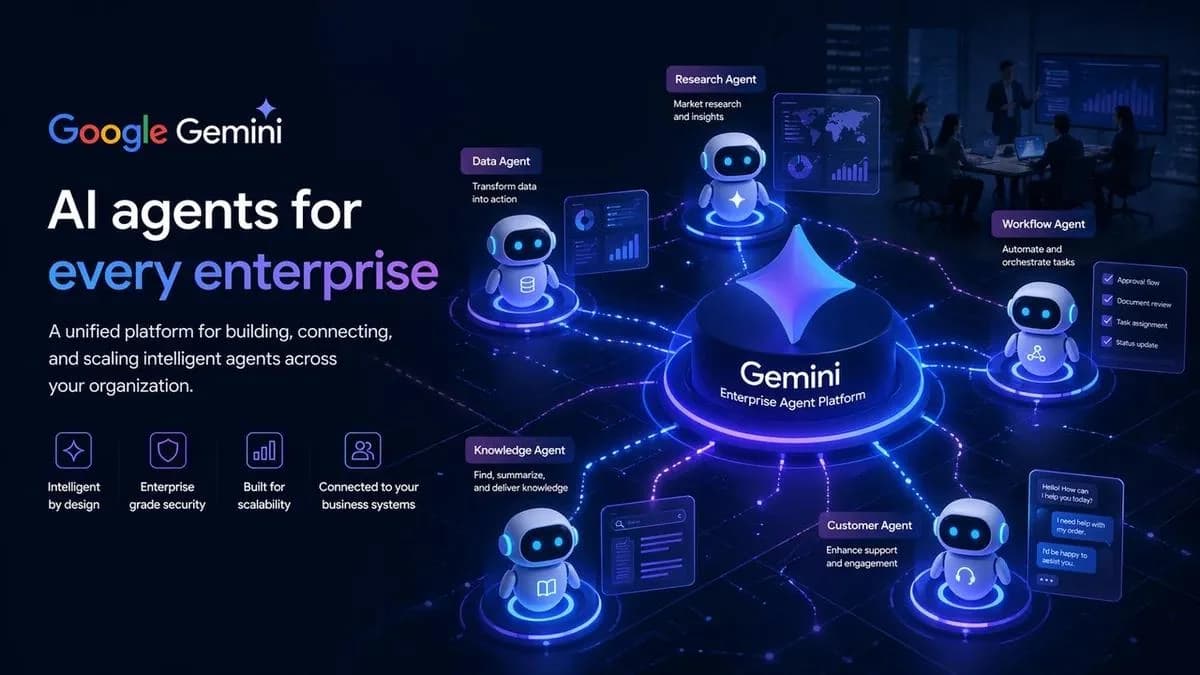 Related illustration — Google Gemini Enterprise Agent Platform Launched at Cloud Next 2026
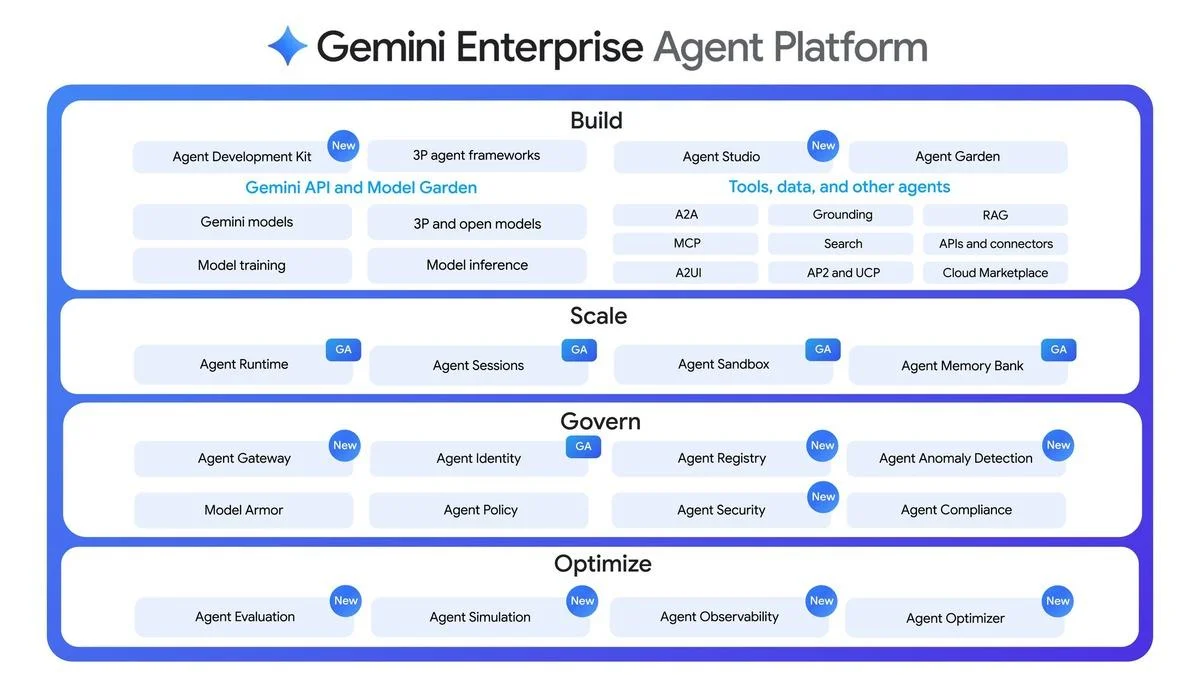 Related illustration — Google Sunsets Vertex AI, Launches Agent Control Plane | Awesome Agents
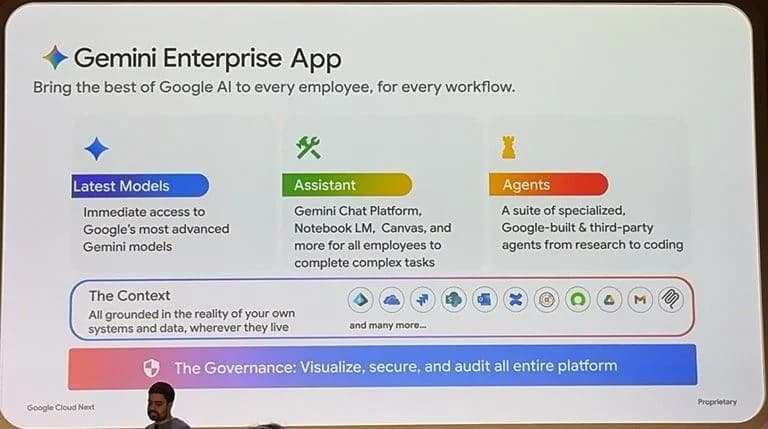 Related illustration — 【Google Cloud Next ’26 レポート】Gemini Enterprise で考える AI エージェントのセキュリティ
![[速報]Google、AIエージェントをローコードで作れる「Agent Studio」含むAIエージェント基盤「Gemini Enterprise Agent Platform」発表 - Publickey](/_next/image?url=%2Fimages%2Fbriefs%2F2026-10-09%2Fstory-01-04.webp&w=3840&q=75) Related illustration — [速報]Google、AIエージェントをローコードで作れる「Agent Studio」含むAIエージェント基盤「Gemini Enterprise Agent Platform」発表 - Publickey
Related illustration — [速報]Google、AIエージェントをローコードで作れる「Agent Studio」含むAIエージェント基盤「Gemini Enterprise Agent Platform」発表 - Publickey
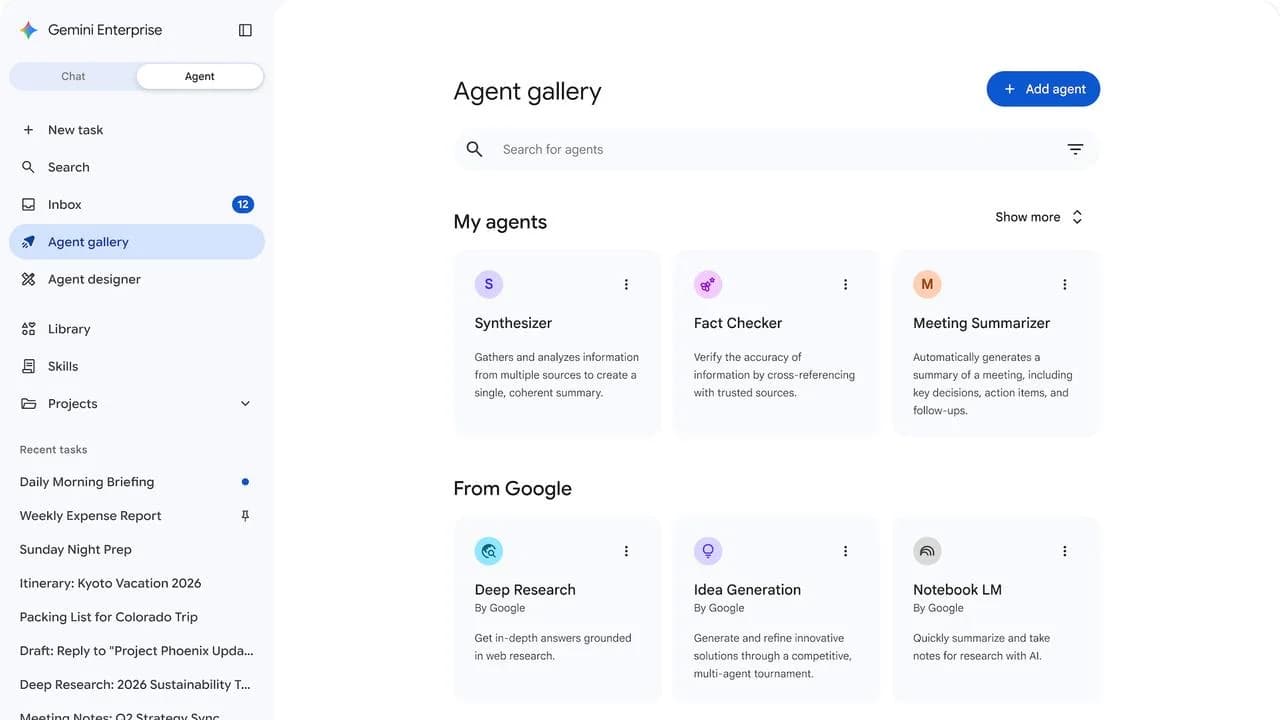 Related illustration — Gemini Enterprise: Un vistazo fresco en Google Cloud Next 2026 con nuevas experiencias de aplicación y un generador de agentes | Pacosite's Blog
 Related illustration — The GenAI Battle Shifts From Frontier Models To Agentic Platforms
Announced: October 8, 2026
Google has introduced a universal enterprise agent designed to execute work across applications rather than simply respond to prompts.
Unlike conventional assistants, the new Gemini agent can maintain persistent context, execute long-running tasks, write code, and coordinate multiple specialized agents. It is initially available to enterprise customers in private preview.
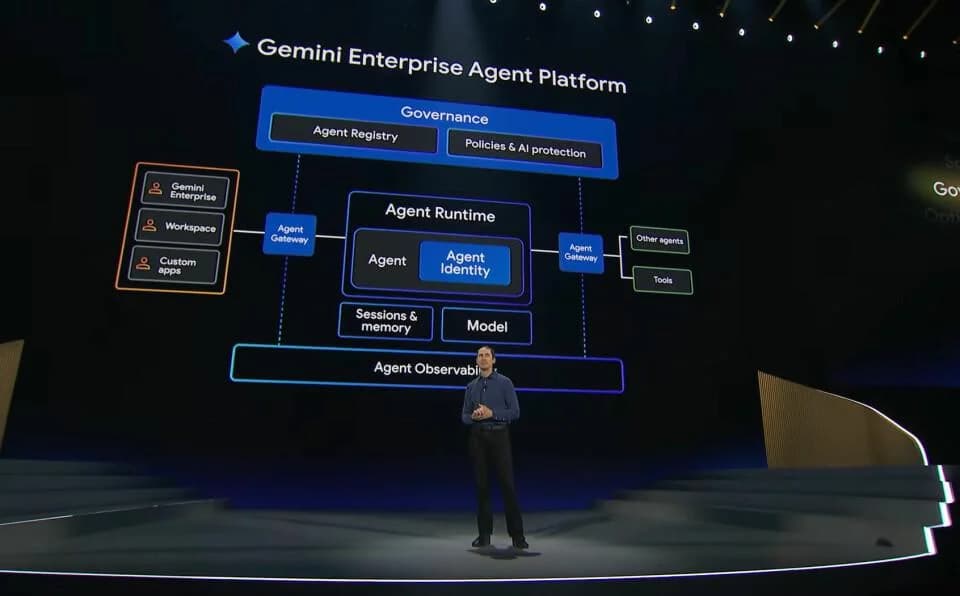
The architecture is particularly interesting because Google is separating the agent runtime from the underlying language model.
Gemini can dynamically select between Google's own models and Anthropic's Claude models, with support for additional private and open models planned.
Its architecture includes several important capabilities.
Persistent execution: Tasks can continue running for hours or days after a user disconnects. Memory and context remain synchronized across devices.
Dynamic subagents: The primary agent can create temporary specialized workers with separate identities to execute tasks in parallel.
Persistent coworker agents: Organizations can create agents with their own email addresses, storage, responsibilities, and controlled access to company information.
Enterprise security: Each agent receives a cryptographically attested identity. Execution occurs in isolated sandboxes, while an Agent Gateway enforces network and data-access policies.
Cost-aware orchestration: Smart Routing selects models based on workload requirements, while spending caps can automatically pause execution when budgets are exhausted.
Why it matters for developers
This is effectively a managed distributed-agent architecture.
Instead of building everything yourself:
Scheduler → Agent → Model Router → Subagents → Tools → Memory → Execution → Audit
Google is integrating these responsibilities into a unified platform.
The most significant design choice is making the model replaceable while keeping the agent's identity, memory, permissions, and execution state persistent.
That is an important architectural pattern for production AI applications, particularly those that need long-running workflows without becoming dependent on a single model provider.
Anthropic launches OSS Scanner — free frontier-model security scanning for open-source projects
Announced: October 8, 2026
Anthropic has launched the Anthropic Cyber Mission, a new initiative focused on finding and repairing vulnerabilities in open-source software and critical infrastructure.
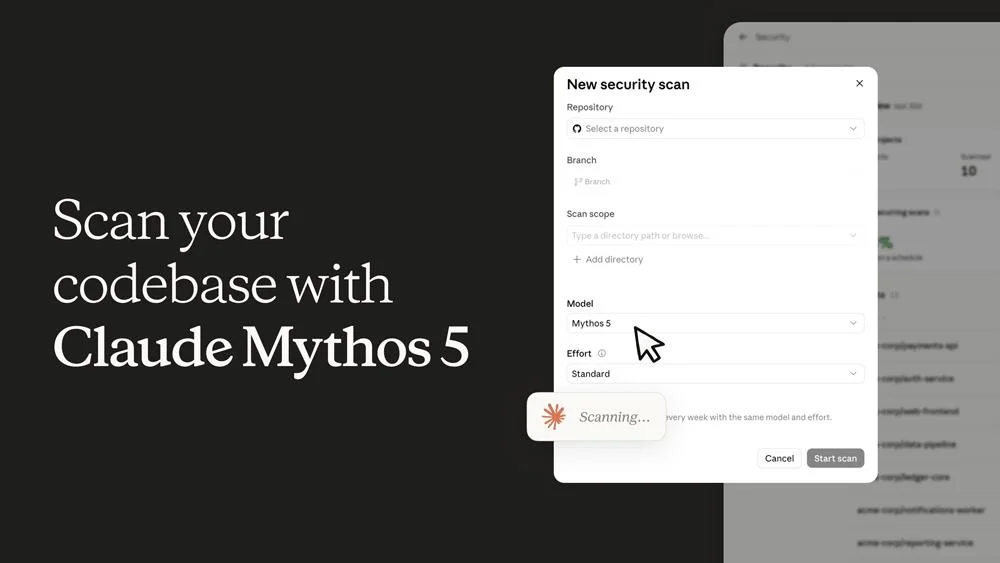
Its most immediately relevant component for software developers is OSS Scanner.
The service offers qualifying open-source projects periodic security scans using Anthropic's most capable models, free of charge.
Each finding can include an explanation of the vulnerability, a proof of concept demonstrating how it could be exploited, and a suggested fix when available.
The important distinction from conventional static analysis is that the system uses frontier-model reasoning to investigate vulnerabilities that may depend on interactions between components, not just recognizable insecure syntax.
Anthropic says the service grew out of Project Glasswing, during which its models examined hundreds of widely used open-source projects.
However, there is an important limitation.
OSS Scanner reports are generated without human review.
Anthropic expects a true-positive rate above 90%, but that is a projected figure, not an independently established production result. Maintainers must still verify findings, severity assessments, and proposed patches.
Why it matters for developers
This represents a shift from security tools that primarily recognize known patterns toward systems that can investigate unfamiliar behavior.
A useful security workflow increasingly looks like:
Source code → AI vulnerability analysis → Reproduction → Patch proposal → Regression tests → Human verification
For backend systems involving authentication, payment processing, authorization, and multi-tenant data isolation, this could eventually identify problems that ordinary linters and dependency scanners miss.
The engineering challenge is no longer simply finding more potential vulnerabilities. It's producing trustworthy evidence and fixing them without introducing regressions.
GitHub builds a specialized ModernBERT model that detects leaked secrets in under 2 milliseconds

Announced: October 7, 2026
GitHub has introduced a specialized AI classifier designed to detect credentials that traditional secret scanners struggle to recognize.
Most conventional scanners depend on recognizable patterns.
For example, an API key might have a distinctive prefix or a predictable character structure.
But consider:
DATABASE_PASSWORD=production-secret-value
There may be nothing distinctive about the password itself.
GitHub's new model uses ModernBERT, a non-generative transformer architecture, to classify candidate secrets using their surrounding source-code context.
The model can distinguish between likely credentials and harmless placeholders such as changeme.
More importantly, GitHub reports that it evaluates candidate batches in under two milliseconds.
That speed is crucial because secret scanning happens on a latency-sensitive path.
GitHub cannot afford to make every push wait several seconds for an autoregressive language model.
The new classifier addresses four competing requirements:
Detection precision, inference latency, throughput, and operating cost.
GitHub estimates that integrating the model into push protection could more than double the number of secrets it prevents.
The new model is already being adopted for post-push AI secret detection. AI-powered push protection remains in private preview, with broader availability planned later in October.
Why it matters for developers
This is one of the clearest examples of why smaller, specialized models can be better engineering choices than frontier LLMs.
A large generative model might recognize an exposed credential, but it would introduce unnecessary inference latency and cost.
A dedicated classifier can make the same category of decision much faster.
The architecture becomes:
Candidate detection → Contextual classifier → Block / Allow
This pattern applies well beyond credential scanning.
Consider authorization anomaly detection, request classification, fraud signals, suspicious configuration changes, and routing decisions.
Engineering takeaway: when a task has a small, well-defined output space, evaluate specialized classification models before introducing an expensive generative model.
Node.js 26.11 introduces new performance, HTTP/2, and observability capabilities
Released: October 7, 2026
Node.js released version 26.11.0, followed by a small corrective release, 26.11.1, on the same day.
Although this is not a major-version launch, it includes several meaningful improvements for backend and infrastructure developers.
HTTP/2 flow control: A new connectionWindowSize option gives applications additional control over HTTP/2 connection-level flow control.
This matters for applications handling many concurrent streams, where flow-control configuration can affect throughput and buffering behavior.
New performance histogram APIs: The perf_hooks module gains histogram.diff() and histogram.snapshot().
These are particularly interesting for applications measuring event-loop behavior and latency distributions.
Process execution limits: The new --process-timeout=N option introduces a runtime-level process timeout.
That can be useful for bounded command execution, test runners, and automation environments.
Additional Buffer utilities: New APIs include Buffer.stringLength() and Latin-1 detection support.
SQLite API changes: The release also renames the synchronous SQLite database and statement classes, so applications using Node's built-in SQLite functionality should review compatibility before upgrading.
Why it matters for developers
The most interesting improvements concern observability and controlled execution.
Modern Node.js applications increasingly run background workers, streaming APIs, AI integrations, and automated tasks.
Those workloads benefit from precise latency measurements, explicit execution limits, and better control over network flow.
The process timeout is especially relevant to agent infrastructure, where generated programs or tool commands should not run indefinitely.
Engineering takeaway: if you're maintaining Node.js backend services, review the new performance APIs and execution controls. For production, remember that Node.js 26 is still on the Current release line at the time of this update; evaluate changes before upgrading established LTS deployments.
Google releases AI Edge Foresight — an offline AI application built around local multimodal retrieval
Announced: October 6; broader coverage October 8, 2026
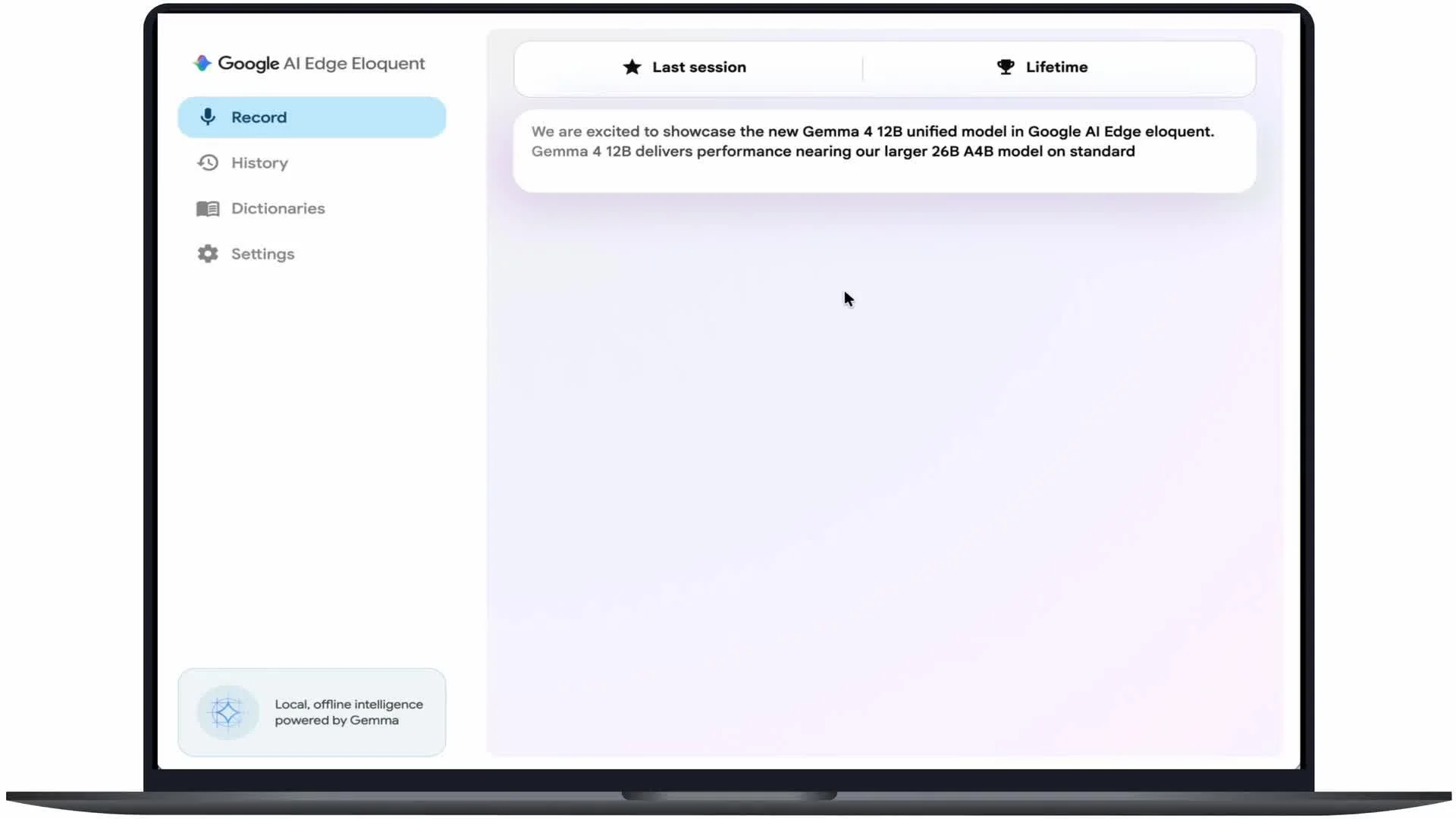
Google has released AI Edge Foresight, an experimental macOS application that demonstrates how capable AI applications can operate entirely on a local computer.
The application records and transcribes meetings, expands shorthand notes into detailed summaries, and lets users search across transcripts, documents, images, and other local information.
It uses two complementary model types.
EmbeddingGemma 2 handles multimodal retrieval by converting information into comparable vector representations.
Gemma 4 provides generative capabilities for answering questions and producing summaries.
Both operate locally, with no cloud inference required.
The underlying architecture is more interesting than the meeting assistant itself.
Instead of uploading files to a remote embedding service, Foresight maintains a local retrieval system:
Local documents + audio + images
↓
On-device embeddings
↓
Local vector retrieval
↓
Relevant context
↓
Local generative model
↓
Answer
Google is also expanding its MediaPipe APIs to make similar architectures easier for developers to implement.
The new Semantic Retriever provides an embedded approximate-nearest-neighbor search engine, while Universal Embedder handles multimodal preprocessing and embedding generation.
Google reports single-digit-millisecond retrieval for its optimized local search implementation.
Why it matters for developers
This is a practical demonstration of local-first AI application architecture.
A desktop application can now provide semantic search, document understanding, and contextual assistance without requiring a cloud inference service for every operation.
That creates interesting possibilities for developer tools: private repository search, local architecture-document retrieval, offline coding assistance, and semantic search across screenshots or debugging recordings.
The broader engineering lesson is that retrieval and reasoning don't necessarily need to live in the same infrastructure environment.
For privacy-sensitive applications, keeping retrieval and context local can be as important as choosing the right model.
The bigger picture
The strongest developments today are about specialization and execution architecture.
Google's Gemini agent separates persistent execution from model selection. Anthropic is using frontier reasoning for complex security investigations. GitHub demonstrates that a tiny, specialized classifier can outperform a generative approach on latency-sensitive security decisions. Node.js continues improving the primitives needed for reliable execution, while Google AI Edge demonstrates fully local retrieval and inference.
The architecture emerging across these developments is:
Persistent agent → specialized models → trusted context → isolated execution → deterministic verification → observability.
For software engineers, the most consequential shift is that the best AI architecture is no longer necessarily the one using the most powerful model everywhere.
It is the one that assigns each responsibility to the appropriate component—and can verify that the entire system behaves correctly.
These briefings combine summaries of linked primary sources with engineering commentary by Emran Hejazi. Source links accompany each story so you can examine the original announcements and their claims.
Every new issue, in your feed reader.
Explore the architecture and engineering decisions behind my projects.